
Frequently Asked Questions
- What is the purpose of the CMF Clearinghouse?
- What is a CMF?
- What is a countermeasure?
- The CMF Clearinghouse presents both Crash Modification Factors and Crash Reduction Factors. What's the difference?
- I've seen the term "Accident Modification Factor" (AMF) before. Is that different than a Crash Modification Factor?
- How can I apply multiple CMFs ?
- What does the star quality rating mean?
- How is the star quality rating different from the notations (bold, italics, etc.) in the Highway Safety Manual?
- How can I submit my own CMF for inclusion in the CMF Clearinghouse?
- Are there available trainings related to the application of CMFs ?
- How does the CMF Clearinghouse relate to the Highway Safety Manual?
- How do you determine statistical significance?
- Who uses CMFs and how are they used?
- How are CMFs added to the Clearinghouse and what is the process for review?
- How do I choose between CMFs in my search results that have the same star rating but different CMF values?
- How can I download CMFs from the Clearinghouse?
- How are states using the CMF Clearinghouse?
- How can I refer to a specific CMF in the Clearinghouse?
- How Can I Do a Sensitivity Analysis with CMFs ?
- How can I compare similar CMFs side by side?
- Why do some CMFs show an increase in crashes?
What is the purpose of the CMF Clearinghouse?
The Crash Modification Factors (CMF) Clearinghouse was established to provide transportation professionals:
- A regularly updated, online repository of CMFs,
- A mechanism for sharing newly developed CMFs, and
- Educational information on the proper application of CMFs.
The purpose of the CMF Clearinghouse is to compile all documented CMFs in a central location. The CMF Clearinghouse provides a searchable database that can be easily queried to identify CMFs to meet user's needs.
The CMF Clearinghouse is updated on a regular basis to add recently developed and documented CMFs. New CMFs are identified via a periodic review of published literature. In addition, the CMF Clearinghouse provides a mechanism for transportation professionals to submit documentation of new CMFs to be considered for inclusion.
Educational information on CMFs includes the About the CMF Clearinghouse page, which summarizes useful information in the form of answers to frequently asked questions. The Additional Resources page provides additional information on related trainings and publications.
The inclusion of all CMFs in the CMF Clearinghouse also serves an educational purpose. One important lesson is that reported CMFs have varying quality and applicability to a given users needs.
The CMF Clearinghouse summarizes published information on each CMF, including how it was developed (e.g., study design, sample size, and source of data) and what are its statistical properties (e.g., standard error). Where available, a link is provided to the publication from which the CMF was extracted.
The CMF Clearinghouse reports this information in a standard format to enable users to make educated decisions about the most applicable CMF to their condition. To aid users in assessing the quality of the CMF presented, the CMF Clearinghouse reports a star quality rating. The star quality rating is assigned based upon the cumulative performance across various factors depending on the study type (i.e. before-after, cross-sectional, meta-analysis, and meta-regression). These factors include study design, sample size, statistical methodology, and statistical significance, amongst others.
The CMF Clearinghouse also reports whether or not the CMF is included in the Highway Safety Manual. The Highway Safety Manual includes only a subset of CMFs that meet strict inclusion criteria. The CMF Clearinghouse provides the broader context of the larger population of CMFs, from which those included in the Highway Safety Manual were drawn.
The CMFs that are included in the Highway Safety Manual will typically have a higher star quality rating given the strict inclusion criteria. High quality CMFs do not exist for every countermeasure and, therefore, there are many countermeasures for which CMFs do not appear in the Highway Safety Manual. The CMF Clearinghouse includes any documented CMF; i.e., it includes CMFs that do not appear in the HSM either because they did not meet the HSM inclusion criteria or because they were documented after the Manual was completed. As a result, the Clearinghouse includes more CMFs for more countermeasures than the HSM.
Inclusion of a CMF in the CMF Clearinghouse does not constitute an endorsement of the CMF or support for its use. The burden is on the user to determine the most appropriate CMF for their analysis need. This determination should be made based upon the CMFs applicability to their condition (i.e. countermeasure being considered and conditions under which it is implemented) and the quality of the CMF.
The CMF Clearinghouse also sponsors an annual webinar to provide guidance on appropriate use of CMFs and best practices from state agencies. Please visit HTTP://CMFCLEARINGHOUSE.ORG/WEBINARS.php to access archived versions of past webinars.
Download the CMF Clearinghouse Brochure (PDF, 2.3 MB)
What is a CMF?
A crash modification factor (CMF) is a multiplicative factor used to compute the expected number of crashes after implementing a given countermeasure at a specific site. A CMF reflects the safety effect of a countermeasure, whether it is a decrease in crashes (CMF below 1.0), increase in crashes (CMF over 1.0), or no change in crashes (CMF of 1.0).
What is a countermeasure?
A countermeasure is a strategy intended to reduce crash frequency or severity on the road. For road safety engineers, a countermeasure is typically a physical change to the infrastructure of a road section or intersection, such as the addition of signs, signals, or markings, or a change in roadway design. The CMFs in the Clearinghouse are presented according to the countermeasure they address. Many countermeasures will have a crash type which is the target for the safety improvement. For example, a protected left turn phase would target left turn related crashes. Sometimes a "countermeasure" in the Clearinghouse is simply a change to the infrastructure – not one that was performed in order to specifically reduce crashes. An example of this is narrowing travel lanes to provide space on the road for bicycle lanes, additional vehicle lanes, or on-street parking. Other types of countermeasures, such as policy changes, education efforts, or law enforcement campaigns, are not covered in the scope of the CMF Clearinghouse, but there are various other resources available on these subjects.
The CMF Clearinghouse presents both Crash Modification Factors and Crash Reduction Factors. What's the difference?
The main difference between CRF and CMF is that CRF provides an estimate of the percentage reduction in crashes, while CMF is a multiplicative factor used to compute the expected number of crashes after implementing a given improvement. Both terms are presented in the Clearinghouse because both are widely used in the field of traffic safety.
Mathematically stated, CMF = 1 - (CRF/100). For example, if a particular countermeasure is expected to reduce the number of crashes by 23% (i.e., the CRF is 23), the CMF will be 1 - (23/100) = 0.77. On the other hand, if the treatment is expected to increase the number of crashes by 23% (i.e., the CRF is -23), the CMF will be = 1 - (-23/100) = 1.23.
These reduction estimates might also be expressed as a function. Crash reduction and crash modification factors are constants; crash modification functions allow the factor to vary for different scenarios, such as for different traffic volume scenarios.
I've seen the term "Accident Modification Factor" (AMF) before. Is that different than a Crash Modification Factor?
Aside from the name, Accident Modification Factor is the same thing as Crash Modification Factor (i.e., AMF of 0.80 = CMF of 0.80). Although the CMF Clearinghouse does not use the term "AMF", there are instances of its use in various areas of the safety field. For example, early drafts of the Highway Safety Manual used the term "AMF", but the decision was made to change the terminology to "CMF" for the final publication.
How can I apply multiple CMFs?
If multiple countermeasures are implemented at one location, then common practice is to multiply the CMFs to estimate the combined effect of the countermeasures. In fact, there is limited research documenting the combined effect of multiple countermeasures. Although implementing several countermeasures might be more effective than just one, it is unlikely the full effect of each countermeasure would be realized when they are implemented concurrently, particularly if the countermeasures are targeting the same crash type.
For example, shoulder rumble strips and enhanced edgeline retroreflectivity would both target roadway departure crashes, so the CMFs for these treatments would be highly related. Other examples of related CMFs would be the use of increased lighting and installation of pavement reflectors, both of which would target nighttime crashes; and chevrons and advanced curve warning signs, both of which would target curve-related crashes.
Countermeasures that would be considered independent are those that target different crash types. For example, the installation of a pedestrian signal would be relatively independent of the installation of a left turn phase at an adjacent intersection, since the one addresses pedestrian-vehicle crashes while the other addresses left-turn opposite-direction crashes. Likewise, the conversion of a left turn phase from permissive to protected along with the installation of an exclusive right turn lane would be fairly independent in that they target different crash types.
Therefore, unless the countermeasures act completely independently, multiplying several CMFs is likely to overestimate the combined effect. The likelihood of overestimation increases with the number of CMFs that are multiplied. Therefore, much caution and engineering judgment should be exercised especially when estimating the combined effect of more than three countermeasures at a given location. The Using CMFs page provides links to training videos on how to select and apply methods for analyzing multiple CMFs.
What does the star quality rating mean?
The star rating indicates the quality or confidence in the results of the study producing the CMF. The star rating is based on a scale (1 to 5), where a 5 indicates the highest or best rating. The review process to determine the star rating judges the accuracy and precision as well as the general applicability of the study results. Reviewers considered various factors for each study (depending on the study type used to develop the CMFs) — study design, sample size, statistical methodology, statistical significance, etc. — and judged each CMF according to its performance in the various factors (including multiple subcategories within each factor). Read more detailed information on the star quality rating system.
How is the star quality rating different from the notations (bold, italics, etc.) in the Highway Safety Manual?
The star rating and the HSM notation are similar but different. Both indicate the same thing, which is a confidence in the CMF based on the quality of the study that produced it. In a rough sense, higher star ratings correspond to a bold face HSM notation and mid-range star ratings correspond to italics and asterisk HSM notations, but there is not a one-to-one comparison laid out between the two systems. The differences exist in the way the CMFs are reviewed to determine their quality.
The HSM review process applies an adjustment factor to the standard error from the study, and then assigns the bold and italic notations based on ranges of the adjusted standard error. The standard error is adjusted based mainly on the quality of the study design. The HSM assigns asterisk (*) or caret (^) notations based on the confidence interval of the CMF, which indicates how accurate the CMF estimate is.
The CMF Clearinghouse review process rates the CMF according to its performance in the various factors (including multiple subcategories within each factor) — study design, sample size, statistical methodology, and statistical significance, amongst others. It assigns a star rating (one through five) based upon the cumulative performance across various factors (with different factors and sub-categories considered for CMFs developed from before-after, cross-sectional, meta-analysis, and meta-regression studies).
How can I submit my own CMF for inclusion in the CMF Clearinghouse?
The CMF Clearinghouse welcomes CMF study submissions. Please use the provided form to submit your study, but please be sure to search before submitting a new CRF as it may already be listed. You may either submit a link to a resource already existing on the web (preferred) or upload your own file.
Are there available trainings related to the application of CMFs?
The National Highway Institute offers training resources on Crash Modification Factors. Please visit the Resources Section to find out more on available trainings.
How does the CMF Clearinghouse relate to the Highway Safety Manual?
The Crash Modification Factors Clearinghouse is just one of the tools and resources available to help transportation professionals make safety decisions. The first edition of the Highway Safety Manual, released in 2010, provides practitioners with the best factual information and tools to facilitate roadway design and operational decisions based on explicit consideration on their safety consequences.
The CMF Clearinghouse incorporates information relating to the HSM within this Web site. Users are able to view and search for CMFs included in the HSM. The CMF Clearinghouse includes all of the CMFs listed in the HSM.
That said, it should be understood that the CMF Clearinghouse only relates to the CMF portion of the HSM (Part D). The HSM also covers many other important topics for highway safety, including safety fundamentals, road safety management, and predictive methods.
How do you determine statistical significance?
A CMF is determined to be statistically significant if the specified confidence interval of the CMF does not include 1.0, since a value of 1.0 indicates no effect from the countermeasure. For a given CMF and standard error, the confidence interval will depend on the significance level that is used. The most common significance levels are 0.05 (corresponds to 95% confidence interval), 0.10 (corresponds to 90% confidence interval), and 0.15 (corresponds to 85% confidence interval).
For the 95% confidence level, the confidence interval is equal to the CMF ± 1.96 * (standard error).
For the 90% confidence level, the confidence interval is equal to the CMF ± 1.64 * (standard error).
For the 85% confidence level, the confidence interval is equal to the CMF ± 1.44 * (standard error).
Example
The CMF for countermeasure A is 0.80 with a standard error of 0.15. The lower and upper limits of the 95% confidence interval are the following:
Lower limit: 0.80 - 1.96*0.15 = 0.80 - 0.294 = 0.506
Upper limit: 0.80 + 1.96*0.15 = 0.80 + 0.294 = 1.094
Since the 95% confidence interval (0.506, 1.094) includes 1.0, this CMF is not statistically different from 1.0 (at the significance level 0.05, i.e., confidence level 0.95)
On the other hand, if the same CMF had a standard error or 0.09, then the lower and upper limits of the 95% confidence interval will be the following:
Lower limit: 0.80 - 1.96*0.09 = 0.80 - 0.1764 = 0.6236
Upper limit: 0.80 + 1.96*0.09 = 0.80 + 0.1764 = 0.9764
Since the 95% confidence interval (0.6236, 0.9764) does not include 1.0, this CMF is statistically different from 1.0 (at the significance level 0.05, i.e., confidence level 0.95)
Who uses CMFs and how are they used?
CMFs are used by several groups of transportation professionals for various reasons. The primary user groups include highway safety engineers, traffic engineers, highway designers, transportation planners, transportation researchers, and managers and administrators. CMFs can be used to:
- Capture the greatest safety gain with limited funds
- Compare safety consequences among various alternatives and locations
- Identify cost-effective strategies and locations
- Check reasonableness of evaluations (i.e., compare new analyses with existing CMFs)
- Check validity of assumptions in cost-benefit analyses
Examples:
- A traffic engineer could use CMFs to evaluate the relative cost-effectiveness of several countermeasures for enhancing signal visibility. Countermeasures included increasing lens size, installing signal backplates, and installing dual red indicators in each signal head.
- A highway designer could use CMFs to compare the cost and safety consequences between paved and unpaved shoulders.
- A transportation planner could use CMFs to compare the long-term safety impacts of a series of roundabouts as opposed to a series of signalized and unsignalized intersections.
How are CMFs added to the Clearinghouse and what is the process for review?
CMFs for the Clearinghouse are obtained either through 1) a regular examination of presented or published material or 2) studies that are submitted by Clearinghouse users through the web site. All studies that are determined to be eligible for the Clearinghouse (i.e., studies that produce one or more CMFs) are submitted to a review process. Presented and published studies considered for the CRF Clearinghouse will be taken from the following sources:
- Transportation Research Board Annual Meeting Compendium of Papers
- American Society of Civil Engineers Journal
- Institute of Transportation Engineers Journal
- Accident Analysis and Prevention
- Journal of Safety Research
- Broad search of existing literature using the Transportation Research Information Services (TRIS)
The review process to determine the star rating judges the accuracy and precision as well as the general applicability of the study results and consider various factors for each study (depending on the study type used to develop the CMFs) — study design, sample size, statistical methodology, statistical significance, etc. CMFs are judged according to their performance across the various factors and are given a corresponding rating score. These ratings correspond to point values in a scoring system that is used to determine the star quality rating.
How do I choose between CMFs in my search results that have the same star rating but different CMF values?
It's true that two or more CMFs for a particular countermeasure may have the same star rating but differing CMF values. It will be necessary for you to examine the information related to the applicability of the CMFs to determine how they differ. This could involve examining the brief data shown on the search results page (i.e., crash type, crash severity, and area type) or looking at all the information about the CMFs by viewing the CMF details page for each one.
You should select the CMF that is most applicable to the situation in which you would like to apply the CMF (i.e., the characteristics associated with the CMF should closely match the characteristics of the scenario at hand). For example, CMFs often vary by crash type and crash severity. While it is useful to determine the change in crashes by type and severity, this should only be done when applicable CMFs are available for the specific crash type and severity of interest.
The figure below shows a snapshot of results for the countermeasure of " Provide a left-turn lane on one major-road approach ". You can see that the three CMFs listed in this figure all have 5-star ratings. However, the CMF values (0.65, 0.71, and 0.91) are all different.
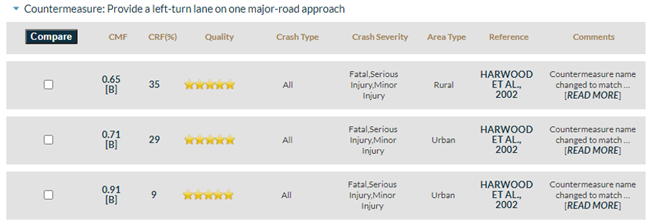
From this initial view of the search results, it is relatively easy to tell the difference between the first CMF and the other two. Although all three are similar in crash type and crash severity, the first one (CMF of 0.65) is identified as being developed for a "Rural" area type, whereas the other two were developed for an "Urban" area type.
However, all information given on the search results page is identical for the second and third CMF. Therefore, it is necessary to examine the details of each CMF (by clicking on the CMF value to go to the CMF details page). When the details of each CMF are examined, it can be seen that the CMF of 0.71 is intended for stop-controlled intersections, and the CMF of 0.91 is intended for signalized intersections.
It may be the case that two CMFs are exactly the same with respect to crash and roadway applicability. In these cases, it will be necessary to examine some of the other fields related to how and where the CMF was developed, such as:
- Score details. The reviewers who established the star quality rating did so by giving scores for various factors (depending on the study type used to develop the CMFs) — study design, sample size, statistical methodology, statistical significance, etc. Many CMFs in the Clearinghouse are accompanied by details of the scores behind the star rating as shown in the image below.

Clicking on the score details link will display a window showing the scores that the CMF received in each category. Users of the Clearinghouse may desire to examine the score details to compare two or more similar CMFs. For instance, although two CMFs may have received the same star rating, one may have used a large sample size while the other may have used a smaller sample size. It may be the case that a user may highly value a certain factor and may use that to decide between CMFs.
It may also be useful to examine the fields in the CMF details pertaining to the scores, specifically sample size and standard error. It may be the case that two CMFs both received a score of "Excellent" for sample size, but one has a sample size of 1,000 while the other has a sample size of 3,000. Both of these sample sizes are large enough to qualify for an "Excellent" rating, however, all other factors being equal, the larger sample size would be preferred. Likewise, two CMFs may have both received a score of "Poor" for standard error, but one has a standard error of 0.75 while the other has a standard error of 0.90. In this case, the smaller standard error would be preferred. - Similarity in locality of data used. The fields for "Municipality", "State", and "Country" indicate the area(s) from which data were used in developing the CMF. Many agencies prefer CMFs that were developed in locations that are similar or nearby to their own area, for reasons of terrain, weather, and other characteristics. For example, a state department of transportation in a mid-western state may prefer using a CMF developed in Kansas over a CMF developed in West Virginia.
- Traffic volume range. The fields for "Major Road Traffic Volume" and "Minor Road Traffic Volume" indicate the range of traffic volumes that were used to develop the CMF. You should examine these fields to see which CMF has a traffic volume range that best fits your situation.
- Age of data. The field for "Date Range of Data Used" indicates the age of the data used in developing the CMF. Generally speaking, more recent data would be preferred (all other factors being equal). Studies conducted more recently typically use more advanced techniques, higher precision data, and have other advantages related to the progression of knowledge, data quality, and study methods that develop over time in the field of highway safety research. More recent data will also better reflect changes in vehicle fleet characteristics and technology.
- Original study report. In addition to providing the citation of the study, the Clearinghouse provides a link, where possible, to the original study document for any CMF. This original document will typically be the final report or published article on the study that developed the CMF. A user of the Clearinghouse who is attempting to select between two similar CMFs may find it useful to refer to the original study report to understand the background of the CMF development. There may be details in the study report that would assist in the CMF selection process. Although the Clearinghouse contains extensive data for each CMF, it does not contain every detail from the study report. For example, the report may discuss details about the roadside character of the roads used in the CMF development. If the roadside character is significantly different from the roads in the user's jurisdiction, he or she may decide to select another CMF that was developed on roads with more similar roadside character to his or her jurisdiction.
How can I download CMFs from the Clearinghouse?
If you would rather work with CMFs in a spreadsheet rather than using the online interface, the CMF Clearinghouse provides an option for downloading CMFs to your local computer. For example, some state agencies maintain an internal list of CMFs that they use for in-house analyses. They use the spreadsheet output from the Clearinghouse to periodically download CMFs and update their internal list. To facilitate this process, the spreadsheet output includes a date field for each CMF that indicates when the CMF was added to the Clearinghouse.
Once you have performed a search using the Quick Search or Advanced Search, you can download the search results in spreadsheet form. Simply click the link at the bottom of the page for "Export all results to Excel". This will give you an Excel output of the star rated CMFs. If there were also CMFs returned for your search that do not have star ratings, and you wish to download those in spreadsheet format, click the link for "view additional results" and then use the Excel export link at the bottom of that page to download the non star rated CMFs.
If you wish to download all the CMFs in the Clearinghouse, do an Advanced Search and leave the search term box blank. This will return the entirety of the CMF Clearinghouse database. Again, if you wish to download these CMFs in spreadsheet form, you will need to download the star rated and non star rated CMFs separately.
How are states using the CMF Clearinghouse?
Many states refer to the CMF Clearinghouse for information on CMFs, traditional and new countermeasures, and other resources related to using CMFs. Although CMFs have been typically used for prioritizing safety projects and developing estimates in cost-benefit analysis, some states are beginning to use CMFs in other situations, such as design exceptions and alternatives analysis.
How can I refer to a specific CMF in the Clearinghouse?
It may be the case that you have selected a particular CMF from the Clearinghouse and you would like to refer to that CMF in a report or communications with other users. To this end, each CMF has a unique ID number (ie, 3127). This CMF ID is listed at the top of the CMF details page (the page that provides all the details about a particular CMF). Additionally, the CMF details page for each CMF has a unique URL (internet address). For example, the link to the details page for CMF #3127 would be http://www.cmfclearinghouse.org/detail.php?facid=3127. The CMF ID is noticeable as the final characters at the end of that URL.
If you would like to locate a specific CMF using the CMF ID number, there are two methods. First, the Clearinghouse search mechanism provides an option for searching for a "Single CMF ID" via a checkbox under the search box. Simply type in the ID number, check the box for "Single CMF ID", and hit submit. Second, you can modify the URL of any CMF details page by replacing the final numbers with the ID number of the CMF of interest.
How Can I Do a Sensitivity Analysis with CMFs?
A sensitivity analysis can be useful if you want to see what the outcome would be for more and less conservative estimates of the effectiveness of a particular countermeasure. Consider the following scenario.
A transportation agency has identified a group of intersections to receive safety projects. The agency has projected that the societal cost of expected crashes will be approximately $175 million per year for this group of identified intersections.
The agency has identified a particular countermeasure to install at each of these sites, based on a diagnosis of the crash data. The total expected cost of this safety project (installing the countermeasure at all identified intersections) is approximately $10 million to cover design, construction, and administration. It is expected that the yearly maintenance costs will total approximately $300,000.
Based on information in the CMF Clearinghouse, the crash modification factor (CMF) for total crashes for this countermeasure is 0.80, indicating that this countermeasure is expected to result in a 20% decrease in total crashes. The Clearinghouse also shows that the standard error for this CMF is 0.05.
However, this CMF was developed in another state, and the agency is not sure if they feel confident that the same benefit could be assumed in their state. Thus, they decide to conduct a sensitivity analysis using the listed CMF value as well as a more conservative value.
First, the agency conducts a benefit/cost analysis using the listed CMF value (0.80, or 20% decrease in total crashes).
- Using the listed CMF, the expected monetary benefit in crash savings would be $175 million per year x 0.20 = $35 million per year. If the agency assumes a countermeasure service life of 10 years, the total benefit would be $35 million per year x 10 years = $350 million.
- The total cost of the countermeasure over this same 10 years would be $10 million initial cost + ($300,000 maintenance cost per year x10 years) = $13 million.
- The resulting benefit/cost ratio would be about 27:1.
Second, the agency calculates a more conservative value by using the standard error (0.05). A common "rule of thumb" is to multiply the standard error by two and add it to the CMF. This approximately reflects a 95% confidence interval.
Conservative CMF = 0.80 + (2 x 0.05) = 0.90, or a 10% decrease in total crashes.
- Using the more conservative CMF of 0.90, the expected monetary benefit in crash savings would be $175 million per year x 0.10 = $17.5 million per year. If the agency assumes a countermeasure service life of 10 years, the total benefit would be $17.5 million per year x 10 years = $175 million.
- The total cost of the countermeasure over this same 10 years would be $10 million initial cost + ($300,000 maintenance cost per year x 10 years) = $13 million.
- The resulting benefit/cost ratio would be about 13:1.
Result: The agency decides that even a conservative B/C ratio of 13:1 is still high enough to justify the funding for this intersection safety project.
Important Notes
1. The expected crash savings in this example are calculated using a very general approach that does not consider the differences in crash severities at the site. A more precise method would be to use multiple CMFs, one for each crash severity type, and a separate crash cost for each severity.
2. For illustration purposes, the expected benefit and cost in this example are calculated as present value but do not include adjustments related to time related factors, such as inflation or a decreasing effectiveness of the countermeasure.
How can I compare similar CMFs side by side?
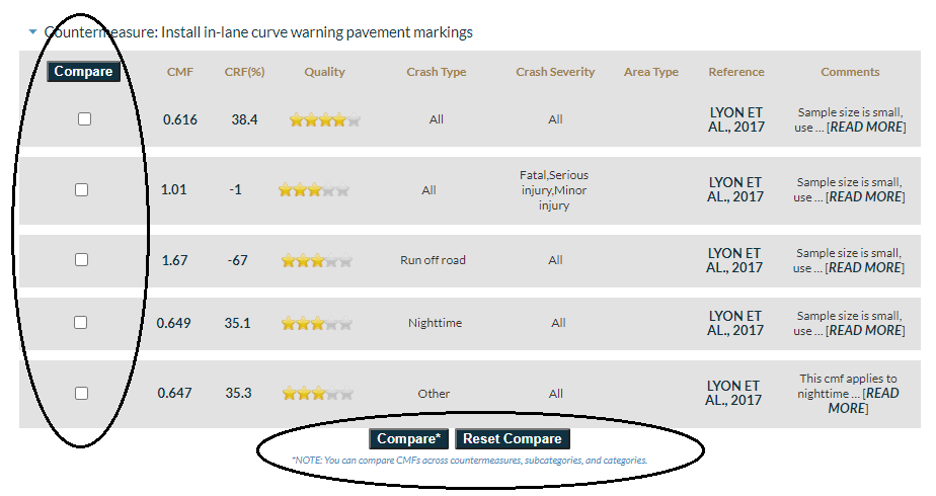
The CMF Clearinghouse has a “Compare” tool that lets you compare up to six CMFs in a side-by-side fashion. Select one or more CMFs from your search results by checking the box next to each CMF and then click "Compare" to see a comparison of all selected CMFs. The comparison page will display all details of each CMF, such as the roadway type, number of lanes, AADT range, intersection geometry, state where the CMF was developed, and more. The comparison page will highlight the fields of data where the CMFs are different. For example, if one CMF was developed on four lane roads and another was developed on two lane roads, the number of lanes row would be highlighted. The intention of this tool is to assist users in selecting a CMF that applies most similarly to the site of interest.
Why do some CMFs show an increase in crashes?
A CMF reflects the safety effect of a countermeasure, whether it is a decrease in crashes (CMF below 1.0), increase in crashes (CMF over 1.0), or no change in crashes (CMF of 1.0). Most of the CMFs in the Clearinghouse indicate a decrease in crashes because most of the countermeasures in the Clearinghouse are intended to reduce crashes. However, there are situations where the Clearinghouse displays CMFs that indicate an increase in crashes. Sometimes, a countermeasure may reduce a target crash type but increase crashes of another type. For example, installing a traffic signal reduces angle crashes (a high severity crash) but increases rear-end crashes (typically less severe). Also, some sets of CMFs in the Clearinghouse show the effect of a range of values, such as changing the width of travel lanes. In these cases, lane widths that reflect a decrease (narrowing) from the original width show an increase in crashes, whereas lane widths that reflect an increase (widening) from the original width show a decrease in crashes.